
Montgomery County Criminal Court Cases
Montgomery County belongs to Iowa Judicial District Four. Iowa does not split local criminal work among separate county and municipal criminal courts. District judges generally hear felonies, while district associate and associate judicial officers handle indictable misdemeanors and simpler matters under the statewide allocation. A Red Oak or contract-town citation filed with the clerk enters the same unified District Court system. A city parking ticket that was never filed may remain outside the state index.
The Montgomery County Clerk of District Court is the custodian of the filed case. The clerk accepts filings and court debt, issues notices, and provides access to the official file at 105 E. Coolbaugh Street in Red Oak. Call 712-623-4986 before a visit. County offices generally post weekday hours from 8:00 a.m. to 4:30 p.m., but the clerk should confirm counter and terminal access. The online result is a useful index, not a certified court record.
Montgomery County Courthouse Terminal
The public terminal at the Montgomery County Courthouse can reveal electronic case detail that an anonymous web search does not provide. Terminal or subscription functions may add schedules, judgment and lien indexes, exhibit lists, bonds, service returns, detail links, and available electronic documents. Recent or pending material can still be on paper. Older inactive files may be stored on microfiche or in another digital form, so the clerk remains the right source for pre-1998 matters and missing documents.
Ask whether the file is available for inspection, as a plain copy, or as a certified copy. An older Judicial Branch guide listed copies at $0.50 per page and allowed added supervision or special-service costs. That figure is not a current quote. Confirm the price and delivery options with the clerk before ordering a large Montgomery County criminal case file.
Searching Montgomery County Case Records
Iowa Courts Online Search is the first remote access layer. Public cases after 1998 are generally indexed, and some earlier cases appear. A new case may take one business day to enter the search, while newly filed documents can take several days. Once entered, indexed data updates in real time. Confidential juvenile, sealed, and expunged matters do not appear.
- Choose Trial Court and select either Name Search or Case Search.
- For a name query, enter at least two letters of the last name. Add first name or exact date of birth when available.
- For a case query, choose Montgomery County and the case type. Enter the 17-character Case ID when known.
- Open the linked Case ID and compare charges, filings, events, status, disposition, and court debt.
- Give the case number to the Montgomery County clerk when requesting an official docket or document copy.
The official statewide court search shows the interface used for this process.
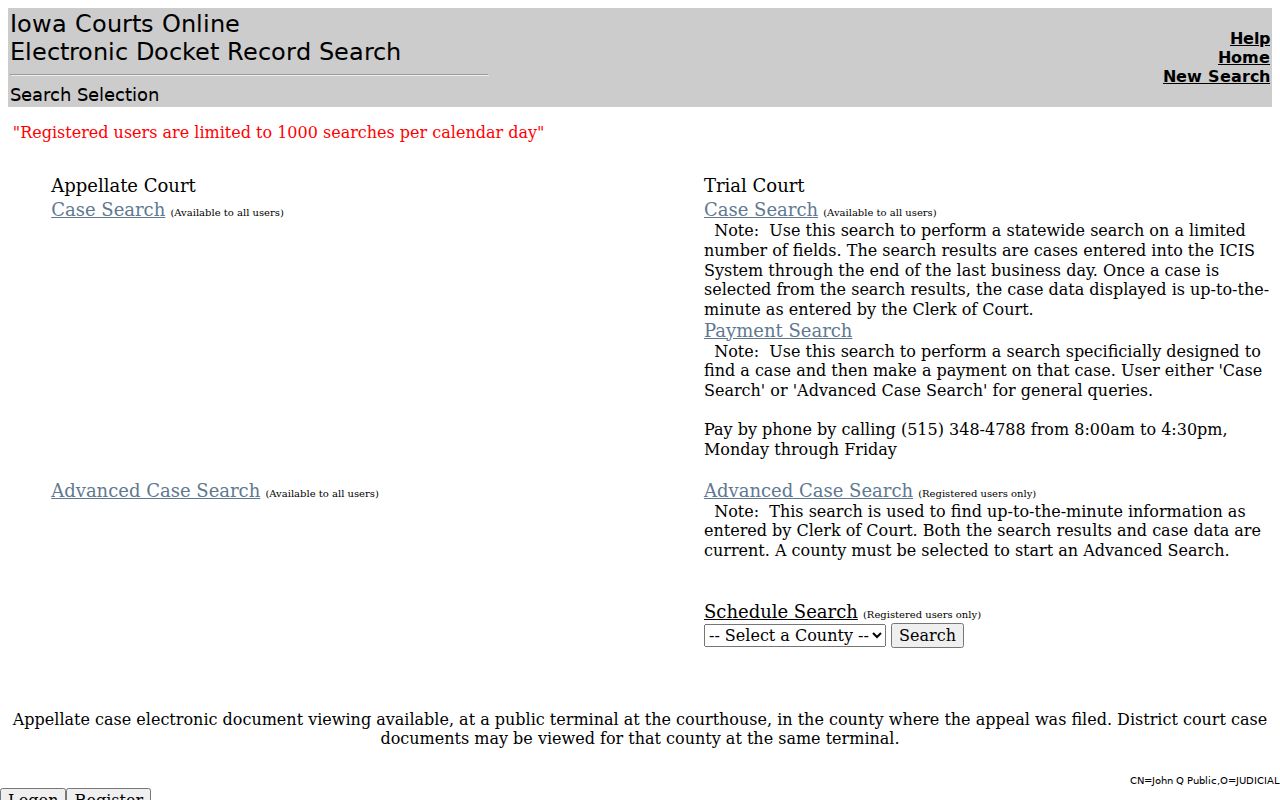
Its county and case-type controls help keep a common-name search focused on Montgomery County rather than all Iowa filings.
Montgomery County Court Search Fields
The search mode changes which fields matter. Name Search supports partial names and a percent-sign wildcard. Date-of-birth mode needs exact birth date, first name, and last name. Case-ID mode uses the county and case type; zero and the letter O are not interchangeable. Citation mode takes a citation number. The official help also warns that a citation may take up to 14 days to post and that spelling can be wrong.
| Field | Type | Use | Format note |
|---|---|---|---|
| Search mode | Route | Required | Name, Case ID, DOB, or citation |
| Last name | Text | Name mode | At least two letters; wildcard supported |
| First name | Text | Optional in name mode | Add it to narrow common names |
| County | Dropdown | Required in Case ID mode | Select Montgomery |
| Case type | Dropdown | Required in Case ID mode | Includes FE, AG, SR, SM, OW, and other codes |
| Case ID | Text | Optional but precise | 17 characters, uppercase; distinguish 0 from O |
The Judicial Branch court-forms library is the official source for forms tied to a case.
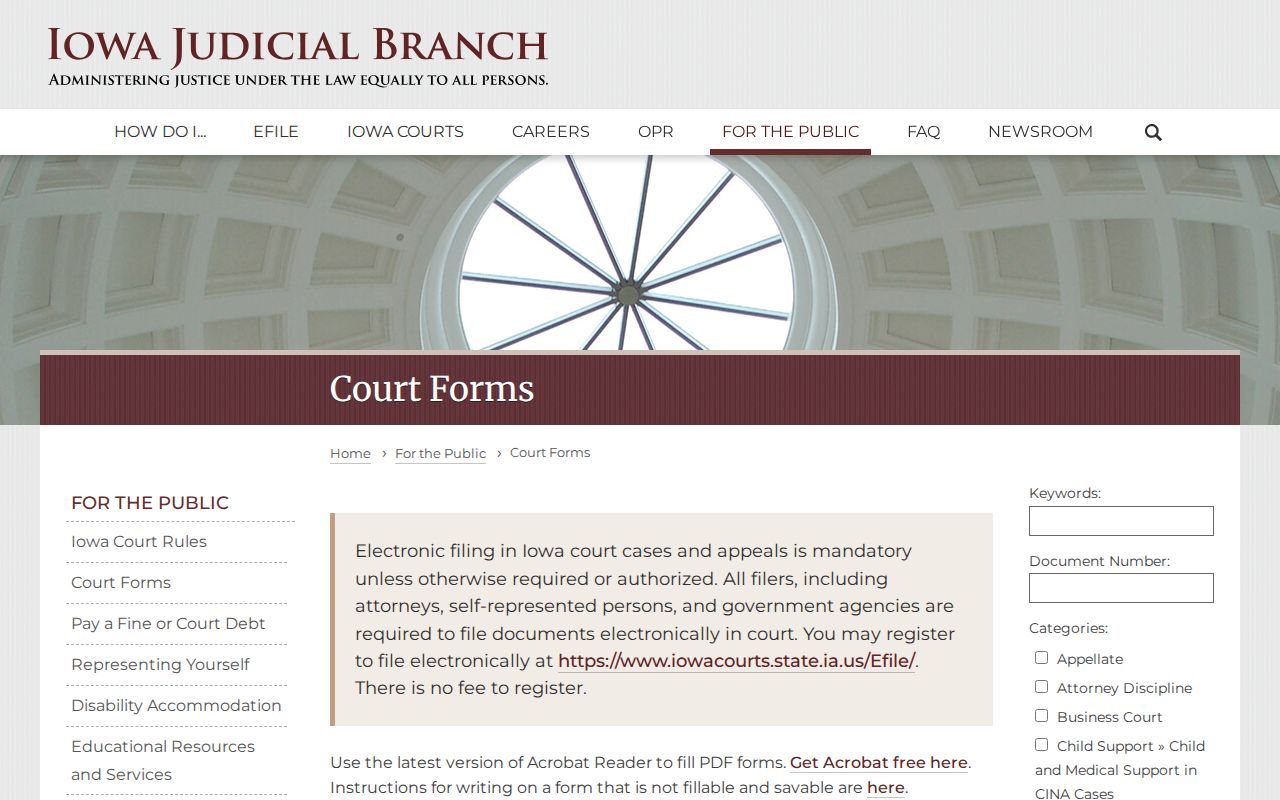
Use the current form rather than an old saved copy when a Montgomery County filing or expungement request requires one.
Inside a Montgomery County Case File
A Montgomery County criminal case file records what the prosecutor filed and what the court did next. It can show parties and lawyers, count-level charges, filings, hearings, bond events, rulings, plea or verdict, judgment, sentence, and assessed debt. The initial booking charge is only an earlier snapshot. It may be amended, replaced, or never filed, so the disposition row and judgment document carry more weight when determining the outcome.
| Case identity | Trial Court Case ID, county, case type, title, opened date, judge, and status. |
|---|---|
| Parties | Names, roles, status, and lawyers shown in the public case view. |
| Charges | Count, code source, offense description, defendant role, result, and result date. |
| Filings | Event or document name, filed date, filer, comments, and status. |
| Bond | Amount, type, poster or agent, dates, disposition, and return or service data when available. |
| Judgment and debt | Disposition, sentence, costs, fine, surcharge, restitution, payments, and balance fields. |
The Iowa court debt payment route provides a convenient financial channel.

Online balances are not warranted as official or timely, so verify a payoff or certified debt figure with the Montgomery County clerk.
Montgomery County Charging Office
The Montgomery County Attorney decides which local charges proceed in court. The office is at 209 E. Coolbaugh Street, Red Oak, IA 51566, and its published phone is 712-623-3011. The attorney's complaint, trial information, or another charging paper starts or advances the prosecution. That filing explains why the court charge can differ from an officer's first allegation.
Counsel appointments are a separate court function. Iowa State Public Defender's Council Bluffs office handles designated Montgomery County case groups, but a 2025 designation assigns only “A's & B's” there. Other classes may go to contract counsel. The prosecutor and clerk do not select private counsel, and the office designation should not be read as proof that every Montgomery County defendant is served from that location.
How a Criminal Case Moves
A complaint, citation, or arrest can start the public trail. The first appearance addresses rights, counsel, and release conditions. The county attorney then decides what to file. Arraignment records the plea. Discovery, motions, and pretrial hearings follow. The matter ends through a plea, trial, dismissal, or other disposition, after which the court enters judgment and any sentence. An appeal creates another layer rather than erasing the District Court docket.
Case flow: Charges Filed › Arraignment › Pretrial › Plea or Trial › Disposition › Sentencing
Note: A sheriff booking charge may change before Montgomery County prosecutors file the formal court count.
Reading Montgomery County Case Details
Iowa case codes help sort Montgomery County criminal court results. FE denotes a felony case family. AG means aggravated misdemeanor, SR serious misdemeanor, and SM simple misdemeanor. OW identifies operating-while-intoxicated matters. CR is criminal, while NT and ST mark nonscheduled and scheduled traffic. CO and CY relate to associate-court matters. These labels classify the file; they do not prove that the first charge survived through judgment.
- Disposition
- The court's recorded result for a charge or case, such as dismissal, plea, acquittal, or conviction.
- Arraignment
- The stage when the filed charge is read or waived and a plea is entered.
- Restitution
- A court-ordered financial obligation tied to loss, distinct from a fine or surcharge.
- Service return
- A filed record showing whether and how court process was delivered or executed.
Financial rows need the same care. Original, paid, due, refund, fine, surcharge, costs, and restitution are separate values. A zero in one column does not mean that the full case debt is cleared. Scheduled activity also describes a future court event, not a final result. When an amount or status will be relied on, ask the Montgomery County clerk to confirm the official entry rather than treating the public screen as a certified statement.
Case Record Access & Restrictions
Iowa Code chapter 22 establishes public-record access, supervision, lawful fees, and confidential categories, but court files also follow Judicial Branch rules. Juvenile, sealed, expunged, protected victim, medical, and other confidential content does not become public merely because someone requests it. Unexecuted warrant applications, orders, and support material may remain restricted until execution and return filing or an initial appearance.
If a public Montgomery County case is missing, give the clerk the name, date range, known case or citation number, and the specific document sought. Ask whether the matter predates online coverage, awaits indexing, exists on paper or microfiche, or has a restricted status. A person disputing a web-index error should contact the filing clerk. A separate DCI repository error follows the challenge route in Iowa Code section 692.5.
Federal Cases Beyond Montgomery County
Federal prosecutions arising in Montgomery County belong to the U.S. District Court for the Southern District of Iowa, not the Montgomery County clerk's full docket. PACER supplies federal docket sheets and filed documents after registration. Quarterly PACER charges of $30 or less are waived, and a court can grant an exemption for cause.
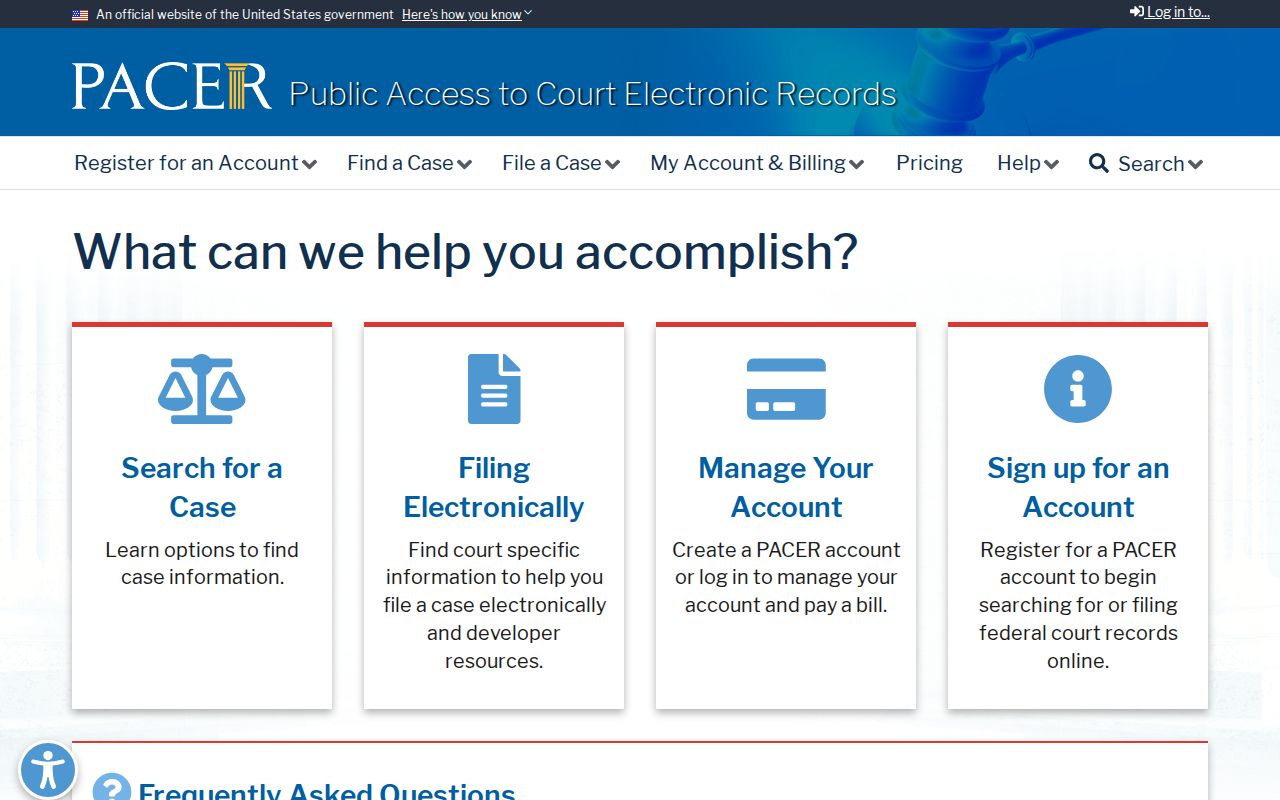
PACER is the direct federal file channel; a county or Iowa Courts Online search does not replace it.
The Southern District of Iowa court site identifies the federal court serving Montgomery County.
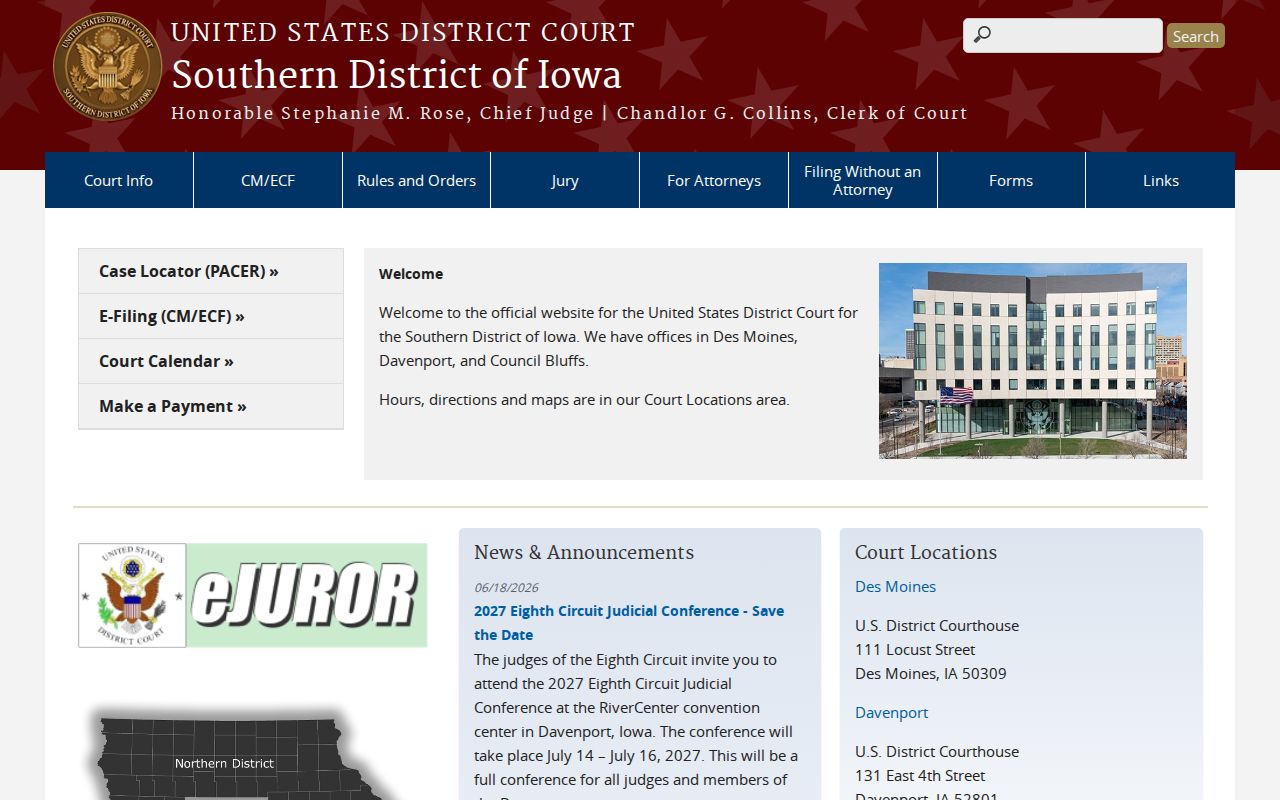
Use that court's information for federal filing and location questions while keeping the local District Court search focused on Iowa charges.