
Checking Criminal History in Montgomery County
No single database contains every Montgomery County criminal record. Start with the event or outcome that matters. Iowa Courts Online can locate a filed case, but the Clerk of District Court keeps the official docket and documents. The Montgomery County Sheriff keeps county booking and custody material. The Iowa Department of Public Safety, Division of Criminal Investigation, or DCI, compiles statewide criminal-history data. Iowa DOC covers people sentenced to state custody or supervision. Federal cases require a separate federal search.
A full name, exact date of birth, spelling variants, former names, case number, and approximate date can separate the right person from a common-name match. Use only identifiers that the official form requests. Then follow the record to its source:
- Search Iowa Courts Online by name or case ID and narrow the result to Montgomery County.
- Call the Clerk of District Court when a document, older case, correction, or certified copy is needed.
- Ask the sheriff or Red Oak Police for the report or booking record created by that agency.
- Use DCI for a compiled Iowa name-based check and Iowa DOC for state custody or supervision.
- Confirm every important result with the office that maintains the original record.
Four Montgomery County Arrest Records
One arrest can produce four related records, and each answers a different question. The arresting officer writes an incident or arrest report about the event. Jail staff make a booking file about intake, property, fingerprints, initial charges, bond, and release. The county attorney decides what to file, and the clerk records the charge, hearings, plea, disposition, and sentence. DCI later compiles arrest and disposition reports into the statewide history chain.
| Record | Custodian | Best use |
|---|---|---|
| Incident or arrest report | Arresting agency | Event narrative and initial allegation |
| Booking record | Montgomery County Sheriff/Jail | Custody, bond, intake, and release |
| Criminal case file | Clerk of District Court | Filed charge and final court result |
| Compiled Iowa history | DCI Dissemination Unit | Statewide arrest and disposition history |
The four views can disagree without any office being careless. A booking charge may change before filing. A dismissal can reach DCI after the court screen updates. A citation can create a case without a jail booking. Treat each record as a dated snapshot and use the case disposition to avoid turning an accusation into a conviction.
Iowa Official Background Checks
The DCI Criminal History Record Check Information page routes public name-based requests. Iowa does not require the subject's signed authorization for this product. Each request needs at least a first name, last name, and exact date of birth. Middle name, sex or gender, and Social Security number are optional matching aids. The fee is $15 per last name, so a person who has used several surnames requires separate forms and payments.
The official DCI page also shows how Iowa criminal history requests are submitted and returned.
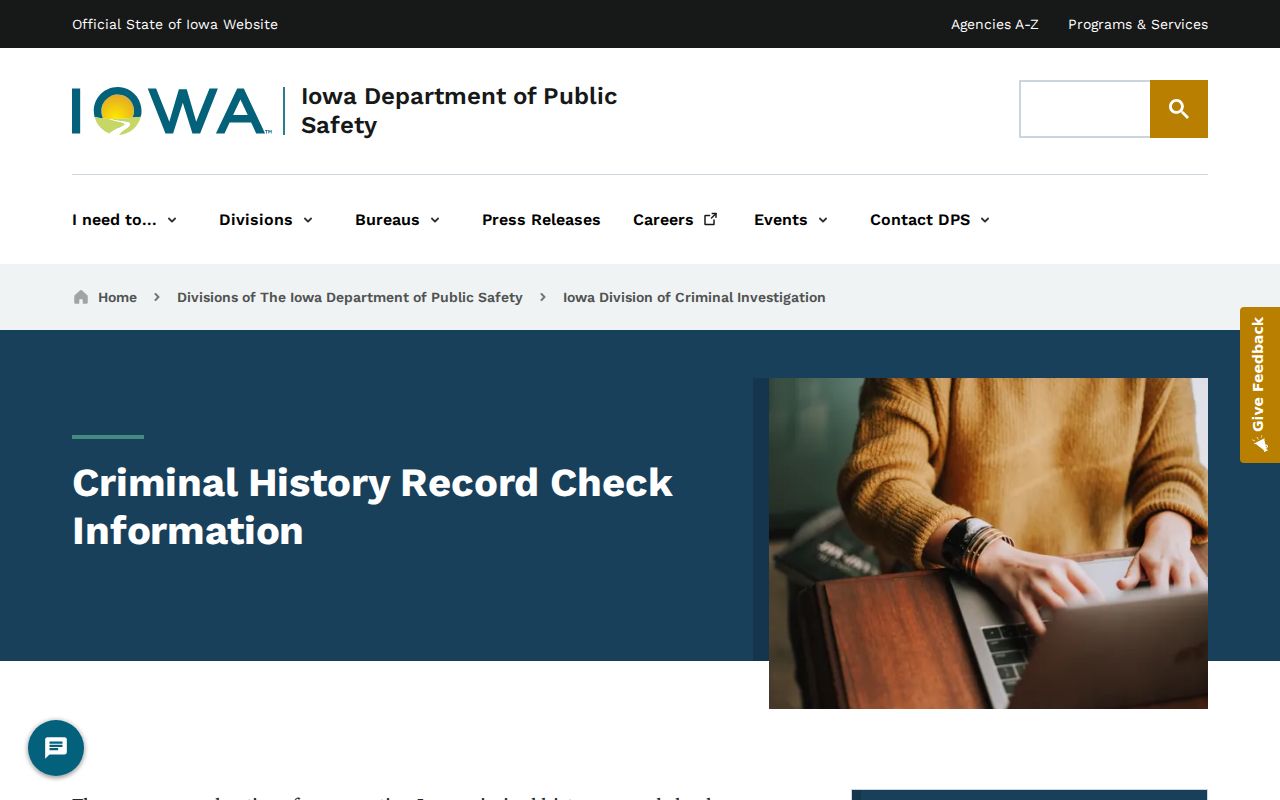
This DCI channel produces an Iowa repository response. It is not a certified Montgomery County court file and not a nationwide fingerprint record.
| Channel | Known cost | Key limit |
|---|---|---|
| DCI name check | $15 per last name | Iowa repository data |
| FBI Identity History Summary | $18 direct request | Subject may review their own fingerprint record |
| Clerk court copy | Older guide lists $0.50 per page | Confirm current price before ordering |
| Sheriff report or copy | Published fee not located | Ask for a current quote and delivery method |
Montgomery DCI Check Versus Case Search
A DCI response and a court search are not interchangeable. DCI compiles reportable Iowa arrest and disposition data. Iowa Courts Online indexes filed court cases and provides richer docket detail, such as events, charge counts, result dates, and financial entries. The clerk's official file may add the charging paper, orders, exhibits, or document images that the anonymous portal does not expose.
For a subject-only federal self-review, the FBI electronic request portal accepts fingerprint submissions through approved methods. The image below shows that distinct federal route.
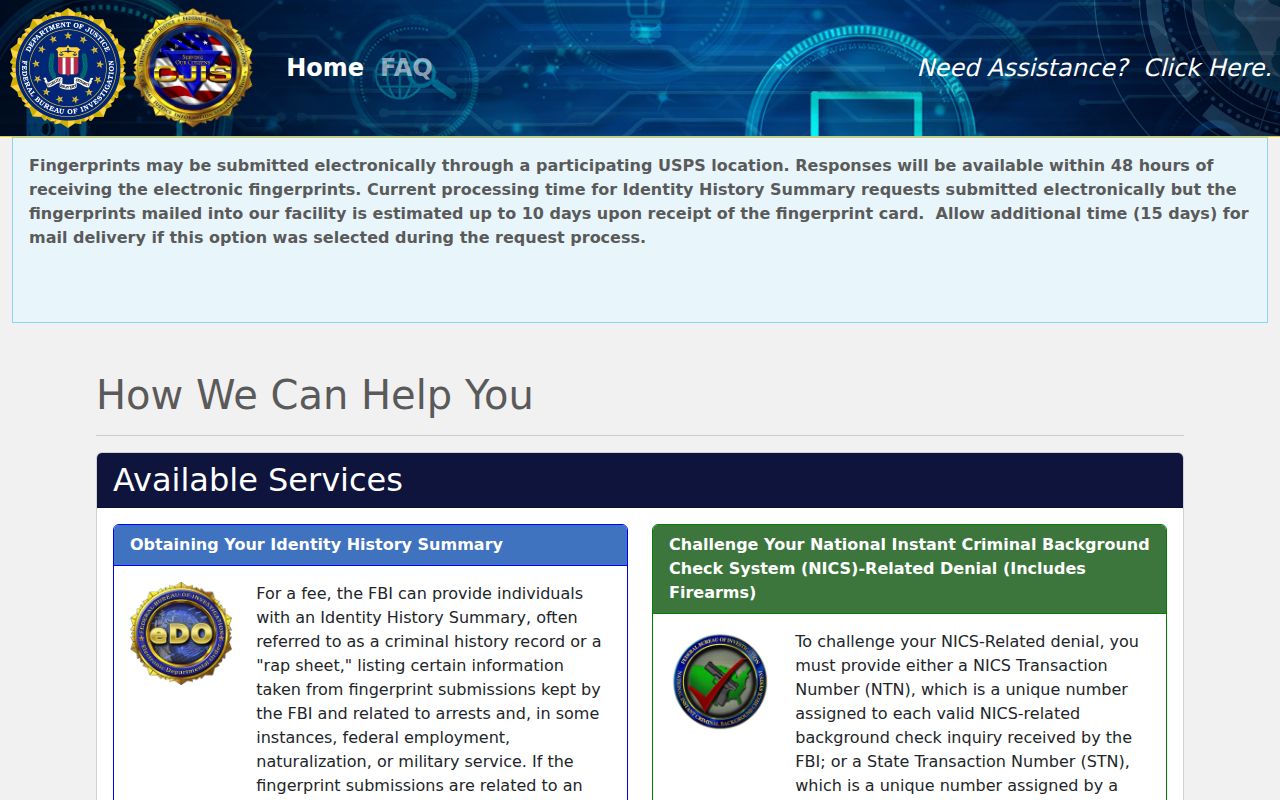
The FBI process costs $18 for a direct request and is designed for people to review their own Identity History Summary. No verified Montgomery County fingerprint appointment site or current local fee was found, so confirm capture options with the sheriff or use the federal locator instead of assuming a local walk-in service.
Note: A repository response may be broader across Iowa, while the Montgomery County court file is more detailed about one prosecution.
Criminal Record Types
Record type determines the right search. An incident report records what an officer reported or observed. A booking record documents custody, not guilt. A court case file tracks prosecution from filing to judgment. DCI assembles statewide criminal-history entries from reporting agencies. Warrants may remain restricted before service. Iowa DOC records concern state prisoners and supervision, while the Iowa Sex Offender Registry is a separate statutory disclosure system.
- Arrest and booking records: initial allegations, intake details, bond, custody, and release information.
- Criminal court cases: filed charges, motions, hearings, pleas, dispositions, sentences, and court debt.
- Repository histories: reportable Iowa arrest cycles tied to later disposition data.
- Warrant records: court and law-enforcement process that can be restricted until execution or appearance.
- Custody and registry entries: specialized state disclosures with their own coverage and limits.
Police, jail, court, DCI, corrections, and registry records should not be blended into a single claim. The originating office remains the best place to interpret an unclear field or correct a source record.
Montgomery Custody Without a County Roster
Montgomery County did not publish an official jail roster or arrest blotter in the sources reviewed. The honest fallback is IowaVINE, which Iowa materials say monitors county jails and DOC facilities statewide. Search by full first and last name or an available ID. A guest search needs no account, and notification tools can track later transfer or release events. A missing result can reflect spelling, a citation without booking, a processing delay, release, transfer, archive status, or a facility data interruption.
For state-sentenced custody, begin at the Iowa DOC offender-search route. Iowa DOC does not replace the county jail channel. Call the Montgomery County Law Enforcement Center at 712-623-5107 when the immediate question concerns local custody, booking data, visitation rules, or a VINE no-match.
Inside a Montgomery County Criminal Record
A compiled record often links a name, aliases, date of birth, agency, arrest cycle, fingerprint identifiers, initial charges, court disposition, and sentence. Public products do not expose every identifier. A local court screen may say much more about docket events, while a DCI response may cover reportable events from several Iowa counties.
| Name and identifiers | Legal name, aliases, date of birth, and available matching data. |
|---|---|
| Arrest data | Charge, date, place, arresting agency, and county of jurisdiction. |
| Case data | Case ID, filed charge, events, counsel, court status, and hearing dates. |
| Disposition | Dismissal, acquittal, plea, conviction, or other court result and date. |
| Sentence | Custody, supervision, fines, restitution, and other terms when public. |
| Status limits | Sealed, juvenile, expunged, confidential, or incomplete information may be absent. |
Iowa Code section 692.5 gives a person the right to inspect and challenge repository data. A court-index error should also be taken to the Montgomery County clerk. Fixing the court screen may not instantly update DCI because the agencies exchange disposition data on separate schedules.
Montgomery Criminal Docket Codes
Iowa Courts Online uses short case-type codes. They help narrow a Montgomery County criminal case search, but a code does not prove how the charge ended. FE marks the felony family, AG an aggravated misdemeanor, SR a serious misdemeanor, and SM a simple misdemeanor. OW identifies operating-while-intoxicated matters. CR is criminal, while NT and ST identify nonscheduled and scheduled traffic cases.
- Disposition
- The formal outcome recorded by the court, such as dismissal, acquittal, plea, or conviction.
- Deferred judgment
- A statutory outcome that can lead to discharge and expungement when all conditions are met.
- Arraignment
- The court stage at which the filed charge is addressed and a plea may be entered.
- Bond
- The court-set release terms or security, not a finding of guilt.
Read the code with the charge and disposition fields. The original allegation may have been amended, and the judgment controls the final court result.
Public Access Laws in Iowa
The Iowa Open Records Law governs access to many agency records, while chapter 692 has separate rules for criminal-history dissemination. Court records also follow Judicial Branch rules. A focused request identifies the creating agency, incident or case number, date range, exact record, and desired format. If only part is confidential, ask for the nonconfidential portion rather than treating the request as all or nothing.
The official Iowa criminal-history law is shown below for direct review.

Chapter 692 distinguishes arrest, disposition, and conviction data, and it supplies access, challenge, reporting, and confidentiality rules.
Key Iowa laws:
Chapter 22 grants inspection and copy rights while preserving listed confidential records.
Sections 692.2 through 692.5 govern dissemination, redissemination, subject access, and challenges.
Chapter 901C defines eligible Iowa expungement paths and limits.
Chapter 692A governs registry disclosure, verification, and public access.
Montgomery Sheriff Record Requests
The Montgomery County Sheriff's Office does not advertise a separately named records division, a fixed copy fee, or a dedicated sheriff portal in the material reviewed. Start with the Law Enforcement Center at 106 W. Coolbaugh Street in Red Oak. Call 712-623-5107 before traveling. Posted administrative hours are weekdays from 7:00 a.m. to 4:00 p.m., but those hours do not prove that every jail service is available throughout that window.
Montgomery County Sheriff/Jail
106 W. Coolbaugh Street
Red Oak, IA 51566
712-623-5107
Weekdays 7:00 a.m. to 4:00 p.m.
Clerk of District Court
105 E. Coolbaugh Street
Red Oak, IA 51566
712-623-4986
Confirm counter hours before travel.
Montgomery County Attorney
209 E. Coolbaugh Street
Red Oak, IA 51566
712-623-3011
Describe the report by incident or booking number, approximate date, involved agency, and requested format. Iowa Code chapter 22 allows reasonable supervision and copy charges. Ask for a quote, delivery method, identification needs, and any legal basis for redaction.
Sealed, Expunged, and Restricted Records
Iowa expungement is narrower than a universal record eraser. Chapter 901C covers qualifying dismissed charges, not-guilty verdicts, and a limited misdemeanor-conviction route. The misdemeanor path generally requires more than eight years, no pending charges, satisfied court debt and restitution, and compliance with a long exclusion list. Section 907.9 provides a separate route after discharge from an eligible deferred judgment.
The current Iowa expungement chapter shows the controlling conditions.
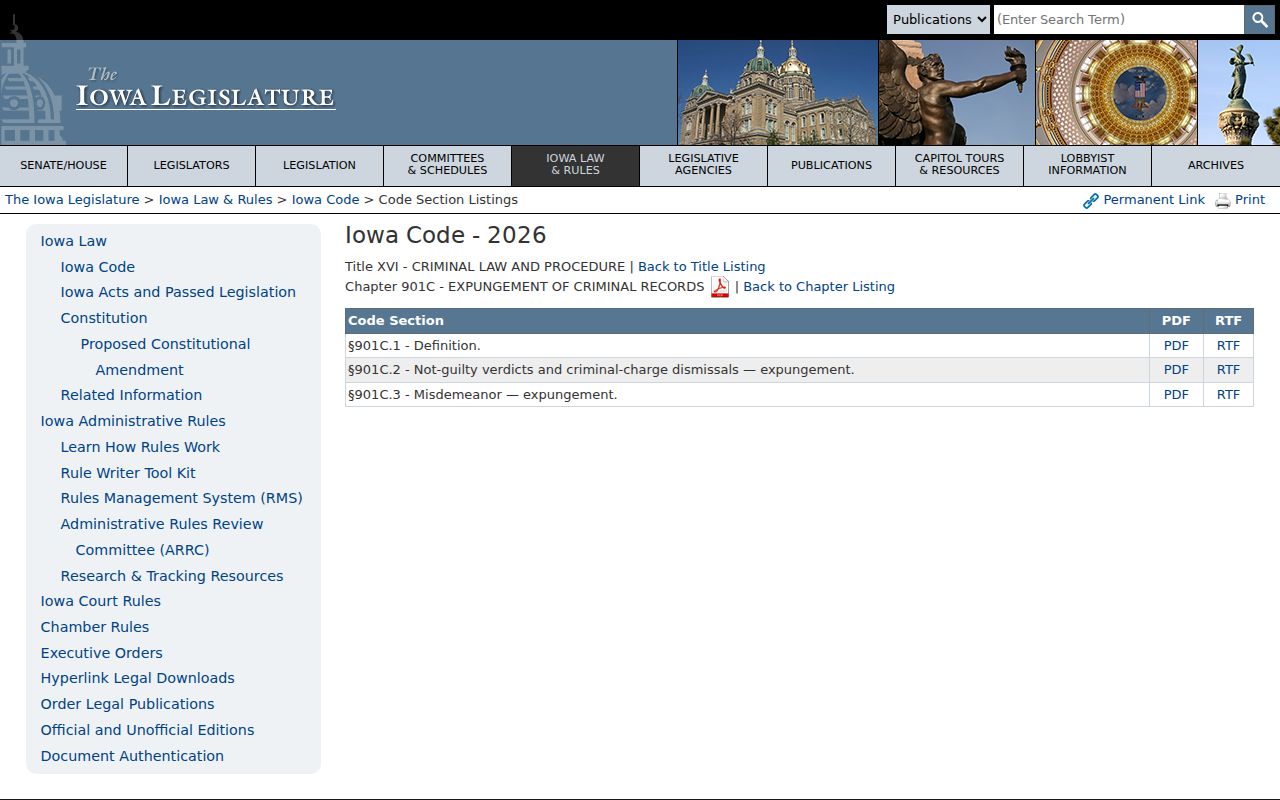
For a Montgomery County case, find the case number and disposition, select the current Judicial Branch form, file in Iowa District Court, and follow the notice steps on that form. Confirm that all financial obligations are paid. An order can make the court record confidential and trigger removal from DPS files, but it cannot promise that every old news story or private copy disappears.
Montgomery Court Records in Red Oak
Montgomery County's record geography is unusually compact. The 1890 courthouse at 105 E. Coolbaugh holds the official District Court file. The sheriff, jail, and Red Oak Police work across the street in the Law Enforcement Center. That short walk crosses three distinct custodians: police for the event report, sheriff for county booking, and clerk for the prosecution outcome.
The courthouse itself followed a dramatic county-seat move. Red Oak won by six votes. In winter 1865, the earlier wood courthouse was placed on runners and pulled by oxen from Frankfort. A blizzard halted the trip and snow temporarily hid the building. The current sandstone and red-brick courthouse was completed in 1890 after contractor litigation and entered the National Register in 1981.
Recent and pending files may still include paper. Older inactive records can be digital or on microfiche. The public terminal may expose detail unavailable through an anonymous Iowa Courts Online search, so the clerk remains the right fallback for pre-1998 matters and certified copies.
Montgomery County Criminal Records by City
Red Oak, Villisca, and Stanton do not share identical city record channels. Red Oak has its own police department. Villisca and Stanton official sites identify no city police-record portal, so sheriff routing matters there. Iowa's unified District Court means none of the three maintains a separate municipal criminal court search. City administrative records stay with the city, while arrest, booking, and filed case records move through the appropriate law-enforcement and county court offices.
Red Oak Criminal Records
2020 population 5,596. City police reports begin with Red Oak Police, while booking and court files use county channels.
Villisca Criminal Records
2020 population 1,132. City administrative records and sheriff law-enforcement records have different custodians.
Stanton Criminal Records
2020 population 678. Start police and booking questions with the sheriff and city records with Stanton.
The official Census county profile provides the broader population context shown in this capture.
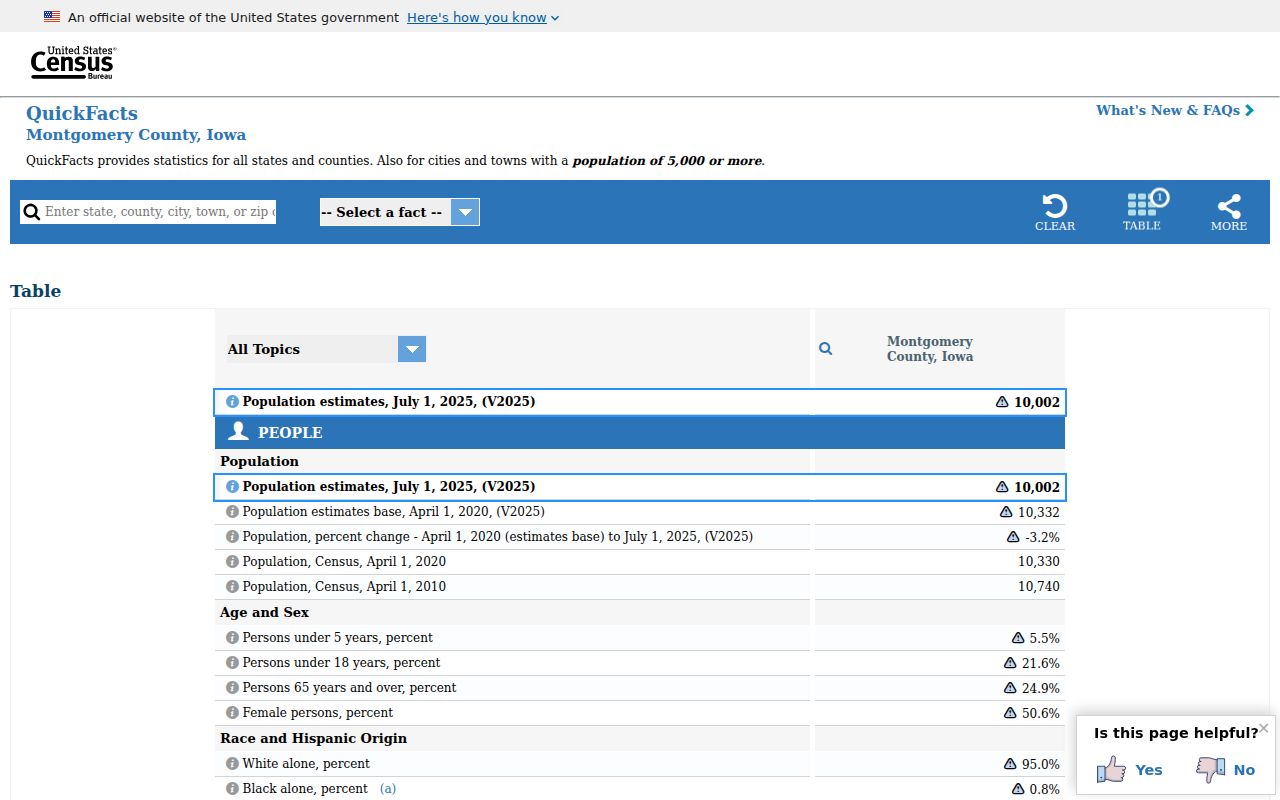
Population is context for the service area, not a crime rate. No reliable official county crime total was located, so city or county risk claims should not be inferred from population alone.
Montgomery Criminal Records After Sentencing
A Montgomery County judgment can lead outside the county for supervision. Iowa DOC's Fourth District serves nine southwest Iowa counties, and its adult probation and parole offices are in Council Bluffs. Iowa DOC Offender Search can show public custody or supervision information for a sentenced person. The Montgomery County court docket remains the source for the sentence and later revocation filings.
The Iowa DOC Fourth District page identifies the regional structure and programs.
Fourth District headquarters is at 801 S. 10th Street in Council Bluffs, with adult probation and parole contacts at that address and at 300 W. Broadway. Protected officer notes, assessments, treatment details, and private data are not the same as an open sentencing order. Check the public docket first, then ask the district only for information it may lawfully confirm.